
For years, optical frequency combs have been one of those photonics technologies that promised a lot, but rarely made it out of the lab. The concept is powerful: A single light source that delivers dozens of perfectly spaced laser lines. But in practice, most combs were big, power-hungry, and far too inefficient for industrial use.
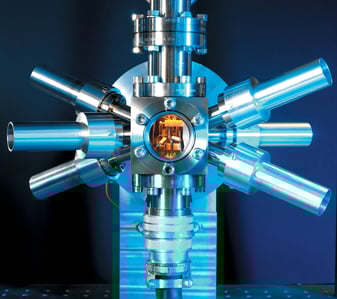 The applications are genuinely compelling. These devices underpin the world's most accurate atomic clocks, enable detailed molecular spectroscopy in the mid-infrared (where chemical signatures are clearest), and help astronomers measure cosmic distances with extraordinary precision. They're also being explored for next-generation terahertz communications, distance measurement, and fundamental physics experiments.
Solinide Photonics, a spin-off from Chalmers University, has managed to change that equation. Their chip-based combs reach over 60% optical efficiency, where most comparable devices stop at 3 - 8%. That’s not just a lab record, their technology can be manufactured in standard semiconductor foundries, paving the way for commercial scalability. The level of performance makes frequency combs viable for datacom and telecom systems, where power budgets and costs per bit matter.
But having a high-performance chip is only half the story. Turning it into a reliable, packaged product is the real ambition, one that often decides whether an innovation scales or stalls.
That’s where PhotonFirst came in. Solinide needed a partner with the experience and infrastructure to handle precision photonic packaging: fiber coupling, laser alignment, and thermal management. All at micron-level accuracy. “Every interface adds loss,” explains Alexander Grabowski, co-founder and design engineer at Solinide. “If your packaging isn’t right, you lose the very efficiency you’ve worked so hard to achieve.”
The collaboration began after an introduction at PIC Summit 2024, when Solinide’s CEO Marcello Girardi connected with PhotonFirst’s engineering team. What followed was a close prototyping partnership. Solinide provided the design vision and specifications, PhotonFirst provided the packaging expertise, cleanroom facilities, and process control to keep that efficiency intact.
Together, the teams produced a fully functional prototype, integrating Solinide’s laser and chip into a compact module that preserved performance and stability during testing. “We delivered a working prototype that met all our targets,” Grabowski says. “It confirmed our architecture is not just efficient on paper, it’s manufacturable.”


The collaboration also offered a key learning point for anyone developing photonic devices:
“When designing a PIC, make sure packaging is part of the thinking process from the very start. It’s tempting to focus only on optical performance, but packaging will define your product’s cost, yield, and scalability.”
For PhotonFirst, the project fits perfectly within its mission: Helping European photonics companies bridge the gap between innovation and industry. With specialized facilities for PIC assembly, fiber integration, and thermal control, PhotonFirst enables companies like Solinide to move from proof-of-concept to production-ready solutions faster and with fewer surprises. Their expertise in system integration plays a pivotal role too.
The result is more than a technical success. It’s a blueprint for how deep-tech organisations and manufacturing specialists can work together to make advanced photonics practical and profitable.
Asked to sum up the collaboration in a single word, Grabowski doesn’t hesitate:
“Efficient, in every sense.”
Are you interested in learning more about PhotonFirst's
PIC Packaging solutions for harsh environments?
