
Amsterdam’s historic canals and bridges were never built for today’s 30‑ton trucks, yet they carry them every day. To keep quay walls and bridges safe without shutting the city down, Amsterdam needs reliable data on what really drives over its infrastructure – not just assumptions.
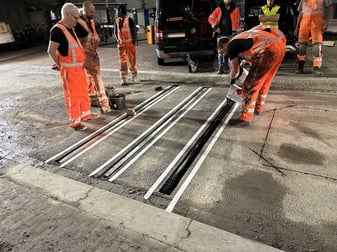
Together with the Municipality of Amsterdam and Technobis, PhotonFirst has installed a fiber‑optic Weigh‑in‑Motion (WIM) system in the asphalt at ‘Droogbak’, next to Central Station. It measures the actual weight of every vehicle in real time – invisible to drivers, but invaluable for the city.
From estimation to real data
Traditional camera systems classify vehicles and estimate weight based on type. But they cannot tell whether a truck is empty or fully loaded, which makes it hard to judge the real impact on vulnerable structures.
By measuring tiny deformations in the road surface with fiber optic sensors, the Droogbak WIM system delivers:
- Axle and vehicle weight
- Speed and direction
- Continuous time‑stamped data for every vehicle pass
This turns “educated guesses” into hard evidence for engineers and policymakers.
What is in the road?
In three narrow grooves in the asphalt, sensor beams with Fiber Bragg Gratings (FBGs) detect strains as wheels pass by. PhotonFirst interrogators convert changes in reflected light into accurate strain signals and then into weight information, all processed in a small roadside cabinet.
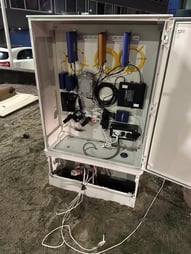 Once installed, the system is invisible, robust and designed to operate for years with minimal maintenance – an ideal fit for busy city streets.
Why fiber optics fit the city
Fiber optic sensing offers key advantages in an urban environment:
- High sensitivity and long‑term stability for trend monitoring
- Immunity to electromagnetic interference from trams and power lines
- The ability to connect multiple sensors along one fiber and scale up efficiently
What Amsterdam gains
For Amsterdam, Droogbak is a step toward data‑driven management of bridges and quay walls. Continuous weight data enables:
- Smarter maintenance and asset planning
- Stronger, evidence‑based policy for heavy vehicles and exemptions
- A solid foundation for future enforcement against overloading
PhotonFirst’s role
PhotonFirst brings years of experience in fiber optic sensing and photonic systems for mission‑critical applications to this project. We provide the sensors, interrogators, data acquisition and signal processing, and work closely with the Municipality of Amsterdam, Technobis and other partners on design and installation.
“Thirty tons of diesel on three thin fibers” nicely captures what this pilot proves: invisible photonics can make a very visible difference in keeping historic cities safe, accessible and future‑proof.
Are you interested in learning more about PhotonFirst's
FIBER OPTIC Sensing solutions for harsh environments?
