
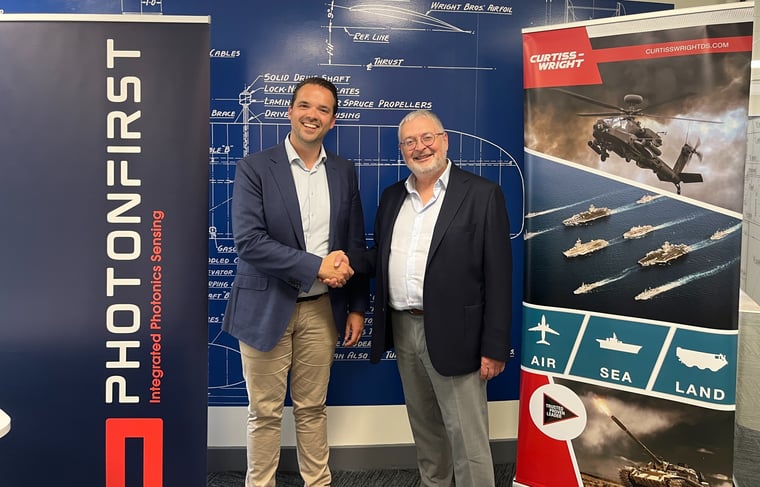
PhotonFirst and Curtiss‑Wright are joining forces to bring integrated fiber optic sensing (FOS) into mainstream Flight Test Instrumentation (FTI), combining PhotonFirst’s Fiber Bragg Grating (FBG) and photonic expertise with Curtiss‑Wright’s leading FTI platforms and global aerospace reach.
Curtiss‑Wright is a global leader in highly engineered aerospace and defense solutions and is widely recognized for its proven FTI systems used across many flight test and space programs worldwide. By adapting PhotonFirst’s FBG interrogators and sensing chains for Curtiss‑Wright FTI architectures, fiber optic sensing can be deployed at scale on both current and next‑generation aircraft platforms, measuring strain, temperature, vibration and structural behavior in harsh environments.
For aircraft OEMs, test centers and defense organizations, this means access to fiber‑based sensing directly within their existing or future Curtiss‑Wright data acquisition, recording and telemetry environments, reducing integration effort and program risk.
In simple terms: from wires to light
Traditional FTI depends on networks of electrical strain gauges, thermocouples and accelerometers connected through heavy wire bundles back to data acquisition units. With FOS, light travels through a single optical fiber, and each FBG along that fiber reflects a specific wavelength that shifts when the structure is loaded or heated. An FBG interrogator translates those wavelength changes into engineering values, making the fiber itself an intelligent, lightweight sensor backbone.
FOS offers several concrete advantages:
-
Major reduction in weight, size and cable harness complexity on the aircraft;
-
Immunity to electromagnetic interference (EMI), supporting accurate measurements near high‑power electrical systems and in harsh environments;
-
High multiplexing: many sensing points (FBGs) on a single fiber, enabling dense instrumentation without adding connectors and wiring;
-
High‑accuracy, real‑time measurements of strain, temperature, vibration and structural health during demanding manoeuvres and extended test campaigns.
All in all, this cooperation will offer richer, higher‑quality data to support safer designs, faster certification and more reliable aircraft over their lifecycle.

Benefits for aerospace & defense from a practical point of view
As the aerospace industry moves toward tighter monitoring and data‑driven operations, structural health monitoring and predictive maintenance are becoming core design drivers. The PhotonFirst–Curtiss‑Wright collaboration directly supports this shift:
-
Better structural insight
FOS enables dense strain and temperature maps across wings, fuselage, control surfaces and critical components, helping engineers understand real‑world loads and aeroelastic behavior in detail. -
Efficiency in test and certification
Higher channel counts on fewer fibers simplify installation and reconfiguration between test phases, helping reduce ground time and support faster certification campaigns. -
Pathway to in‑service monitoring
Technology qualified in demanding FTI environments can later be leveraged for permanent on‑aircraft structural health monitoring, enabling condition‑based maintenance and extended service life.
As Aidan Darmody of Curtiss‑Wright notes, airframers and defense customers are continuously looking for solutions that reduce weight, improve reliability and maximize actionable data during both testing and operation. FBG‑based sensing, integrated into proven FTI building blocks, is well positioned to become an important part of future architectures supporting these goals.
What happens next
Under this collaboration, PhotonFirst’s FBG sensing products and integrated photonics‑based interrogators will be adapted and optimized for Curtiss‑Wright FTI environments and system architectures. This includes aligning hardware and interfaces so that fiber optic sensing can be treated as a native data source inside Curtiss‑Wright acquisition, recording, telemetry and analysis ecosystems.
Both companies expect demand for FBG‑based sensing solutions in aerospace to grow rapidly as programs focus more on structural health, predictive maintenance and platform efficiency. Further details on joint roadmaps, qualified configurations and early deployment programs will be announced at a later stage.
Discover our solutions for harsh environments!
If you are looking for more information about this cooperation and the solutions we provide for aerospace and defense, check this page on aerospace and defense.